Week 5: 3D Printing and Design
Scanning, PLA, and Prusa: Oh My!
This week's project was to design and print a 3D object that could not easily be made by subtractive methods. I was particularly excited about this task, as I have heard so much about 3D printing through the years and couldn't wait to try my hand at it myself! Getting a grip on the workflow was probably the most important facet of my learning process this week -- I learned a goodly bit about transferring files and transforming file types so each software or machine could do its job!
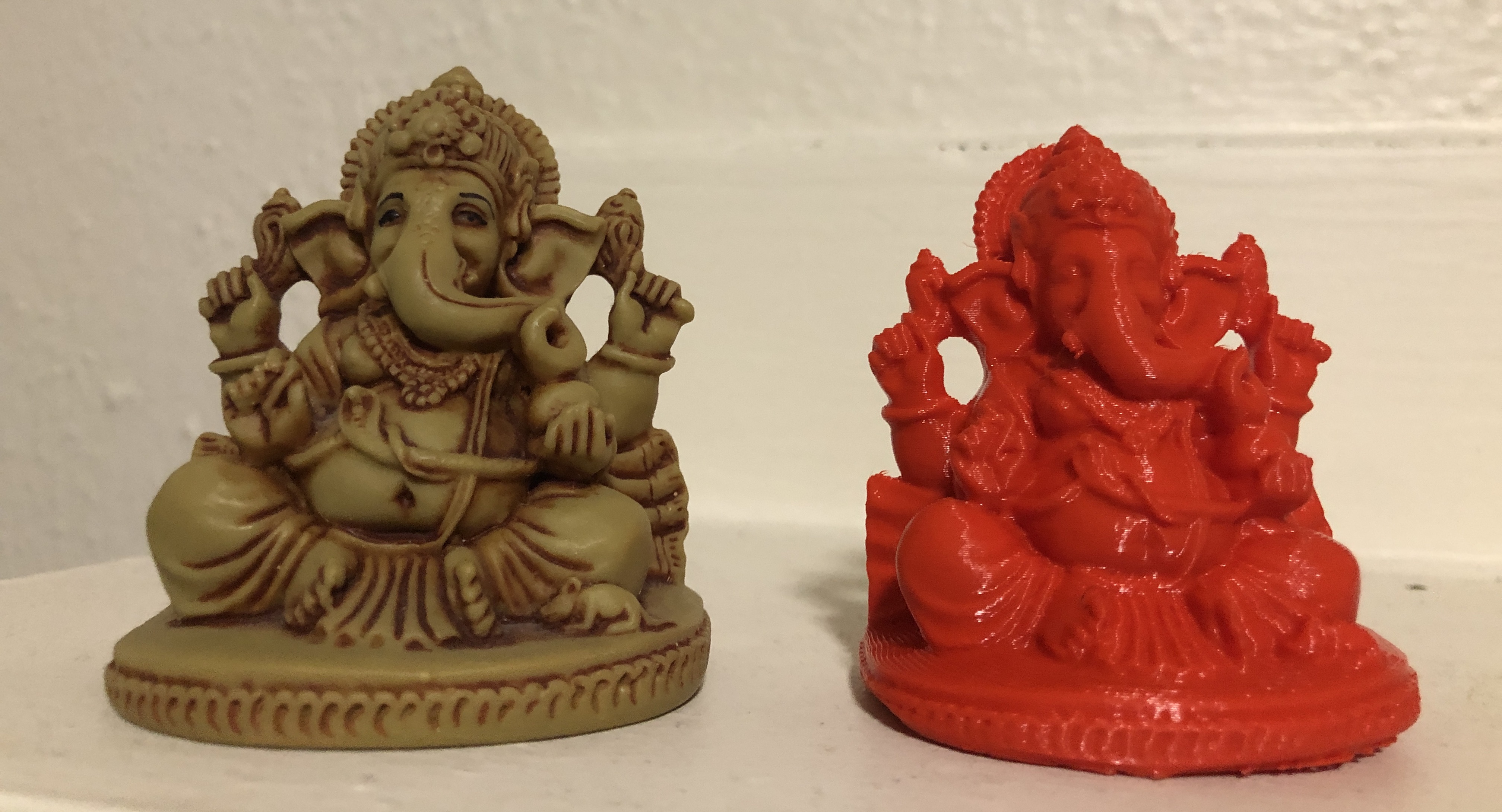
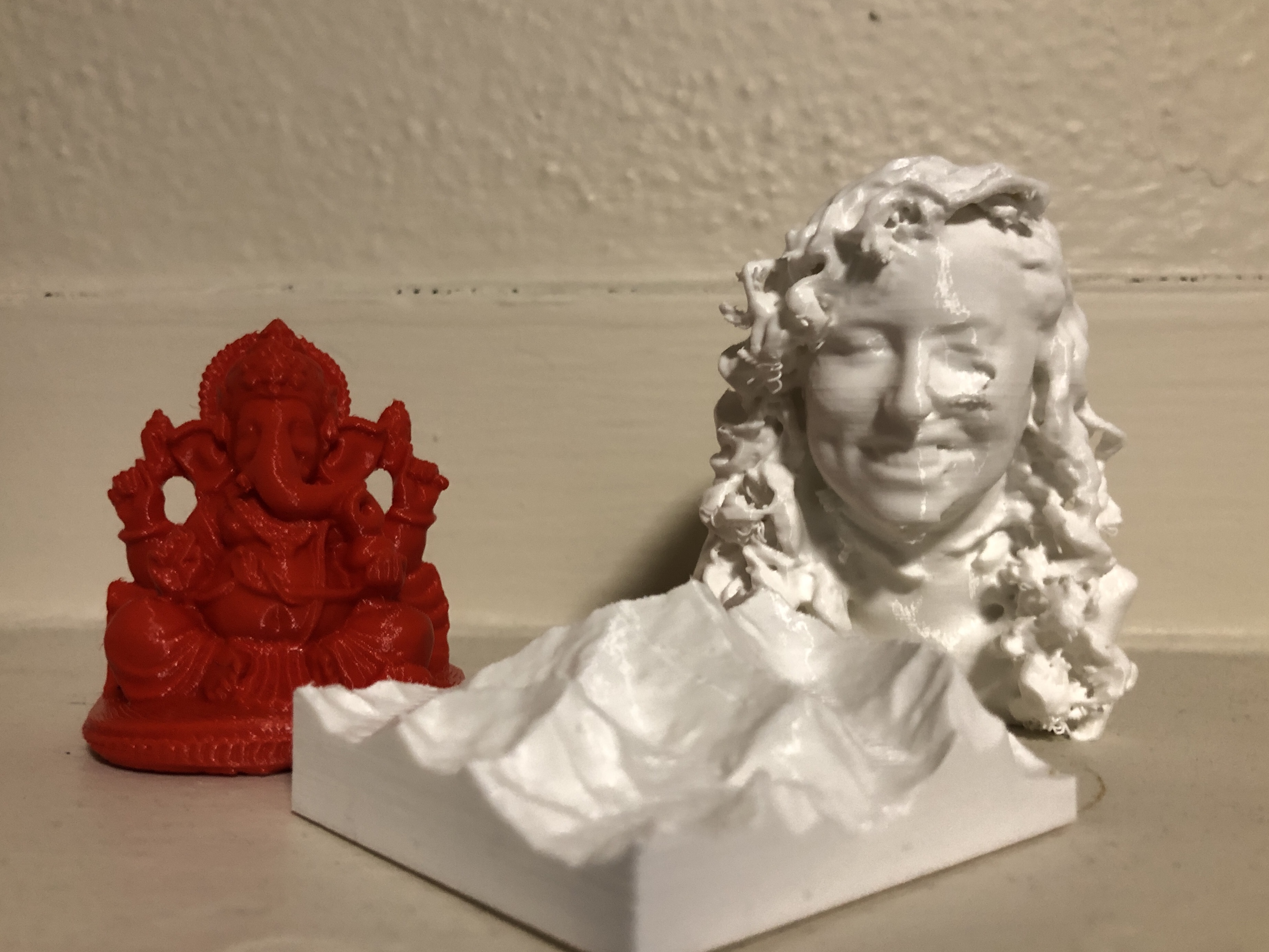
My first order of business was to design a few 3D shapes in Fusion 360 (the likes of which included "the cylinder" and "the cube"). However, instead of printing these out, I decided to cut my teeth on something a little more intricate (from a printing standpoint). I used the Artec Spider Scanner (valued at $24,800; I'm a lucky gal!) to scan a statuette of Ganesh (the Hindu god of beginnings, known worldwide for its iconic elephantine figure); the figurine boasted many nooks and crannies and suspended arms that would not be able to be achieved by subtractive manufacturing nor captured by a different scanner, so I thought it the perfect candidate. Indeed, the scanner returned an exceptionally intricate design that preserved almost every detail on the statue, which was thoroughly impressive. This job took around 3 hours to print, and I scaled it down slightly to abbreviate the estimated time.
Ain't No Mountain
After scanning the Ganesh statuette and figuring out the transfer process from polygon mesh to the slicer's g-code to the Prusa printer by way of SD card, I looked forward to doing some work
in Fusion 360 to design an object to print. After some brainstorming, I thought it might be fun to explore topography and elevation in the natural world and model it in three dimensions. I found
this amazing website called Terrain2STL, into which you put your coordinates of choice and select the size of the area of interest. Users can even
manually lower sea level to emphasize and enhance height differentials. I tried a series of locales, but I found that the Himalayas worked particulary well, for pretty obvious reasons in that I could not zoom in
all that far with Terrain2STL.
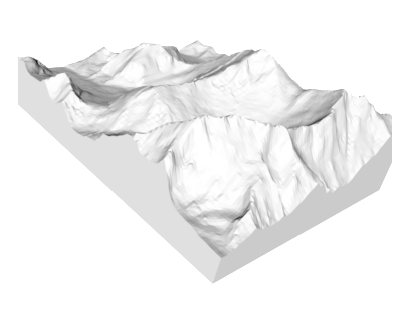
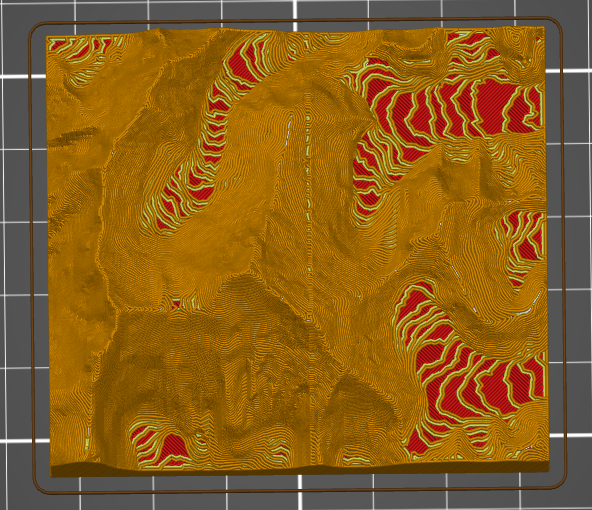
I brought this STL into Fusion, where I redefined it as a body and made an appropriately-sized base for the topography to be displayed on. I sent this off to the
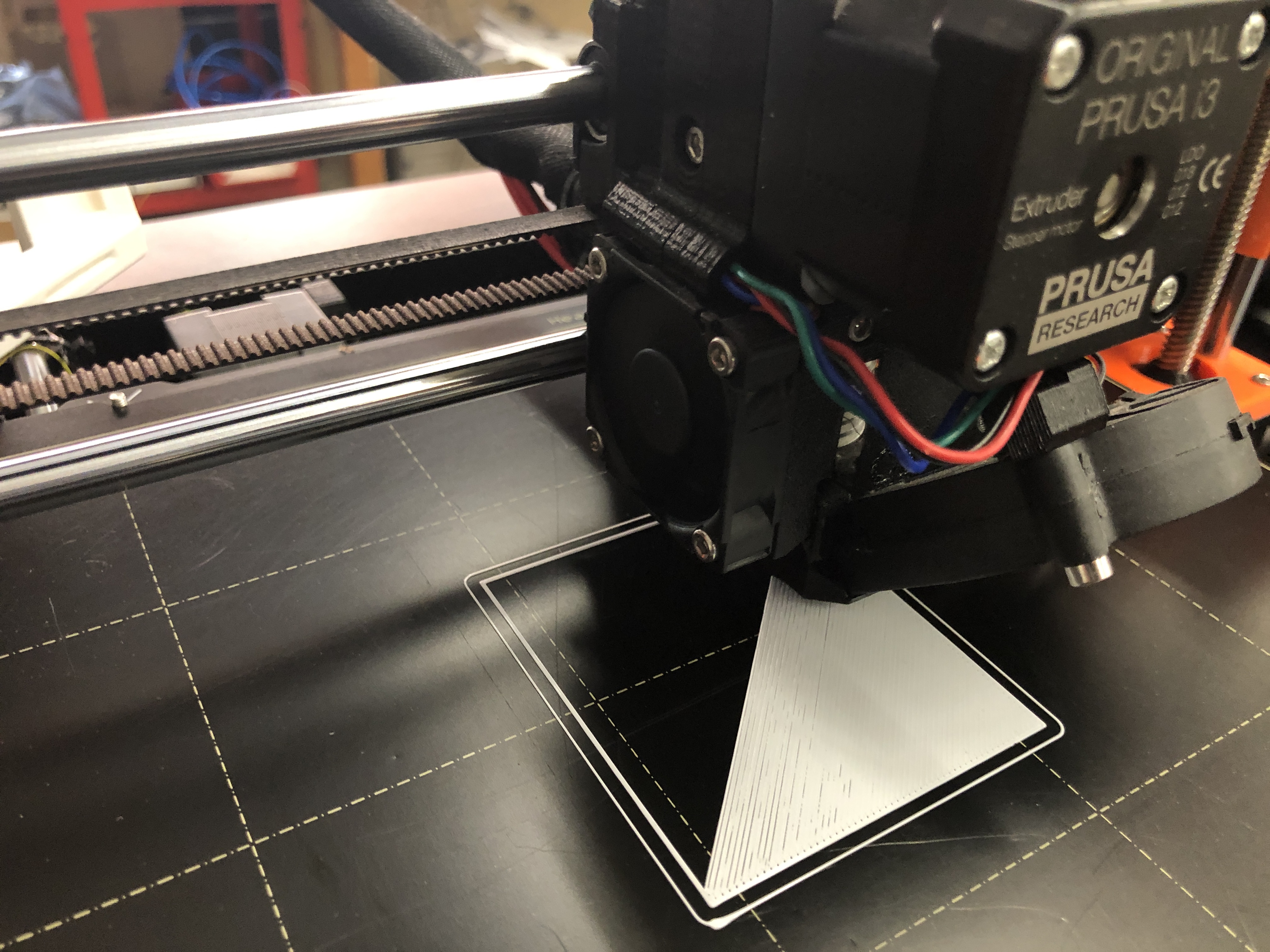
Prusa Slicer and then to printer. After in first go-round, I saw that the printer had stopped working, reporting an error of "Thermal Runaway". None too auspicious! I tried turning the fan off
on my next iteration (per Victoria's counsel), but this threw the same error at the same point on the second layer. I tried once more on a different printer, and it still didn't work. So, I went back into Slicer
and changed the printing settings to ensure it the fan was not running 100% the entire time. Sure enough, that worked! This print job took about 2 hours.
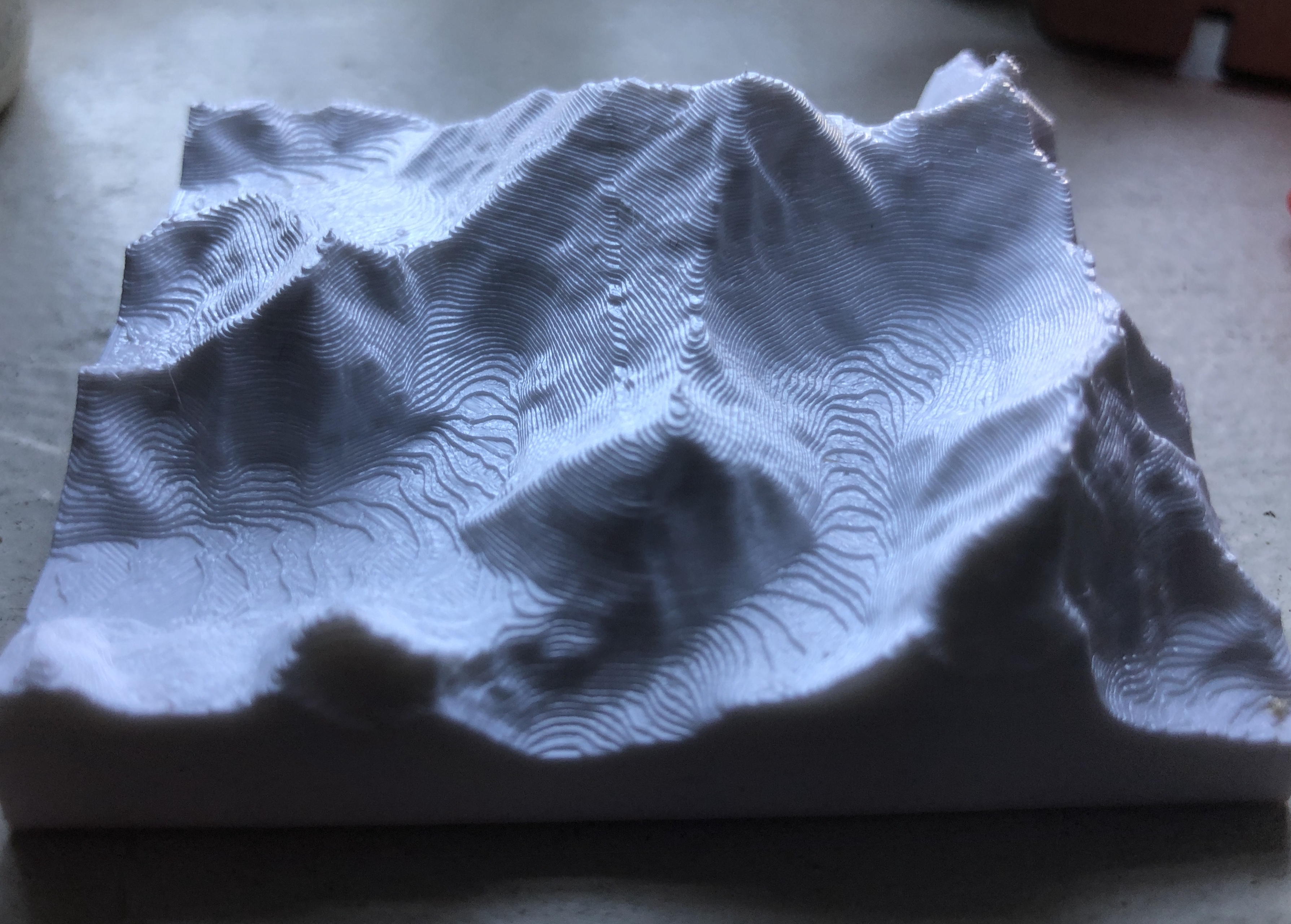
The Regal Rena Bust
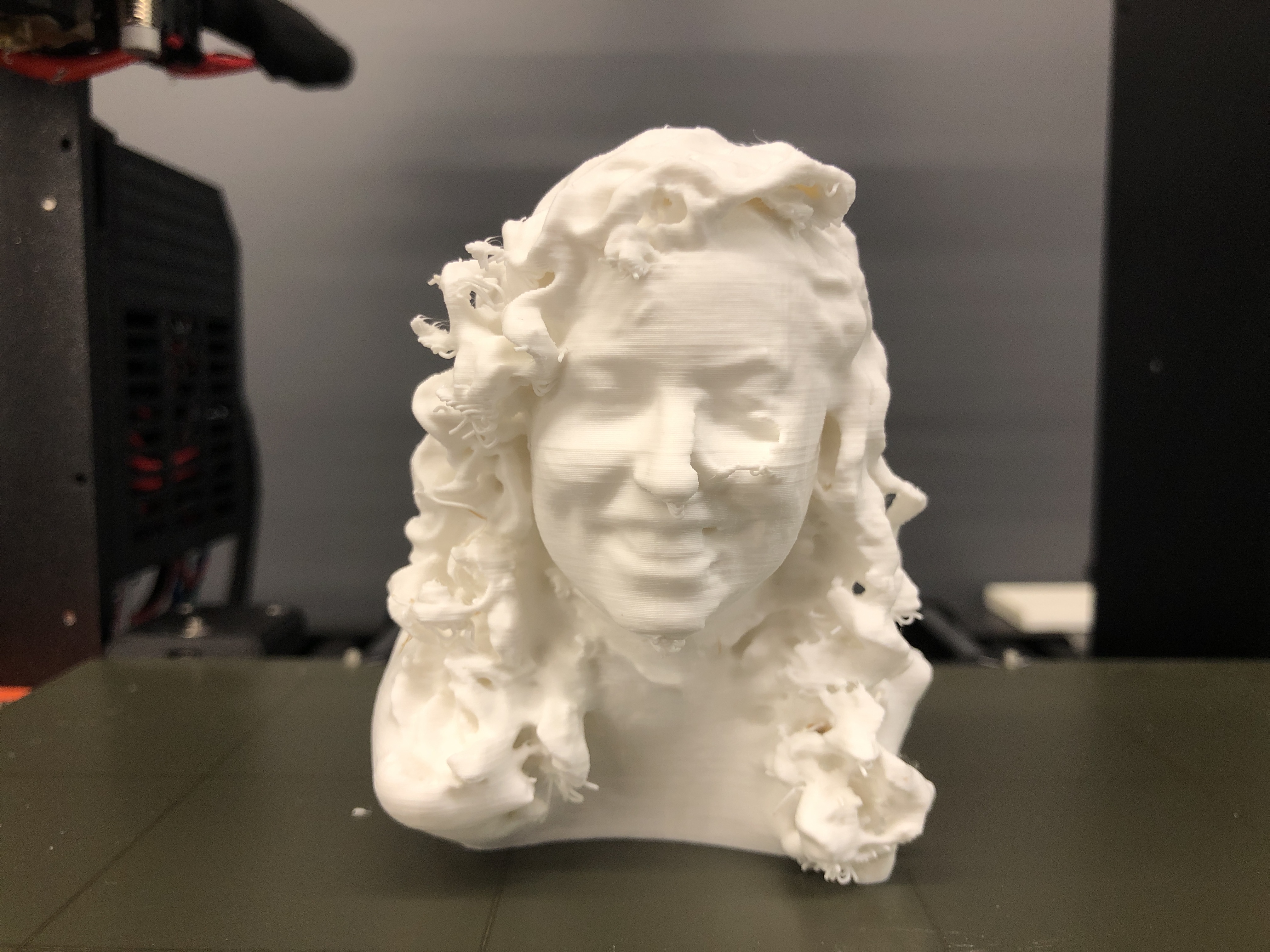
After letting the mountain run its course, I came back to the Fab Lab accompanied by my friend Rena to pick it up. When I showed her around, she was particularly excited by the scanner, so, naturally, I offered to scan her head. (Many snaps to her for her enthusiasm and good-sportedness). In class, we found that many folks had difficulty getting their subjects' hair to show up due to its reflectivity. So, we were surprised to observe that Rena's curls were captured up extremely well by the scan.
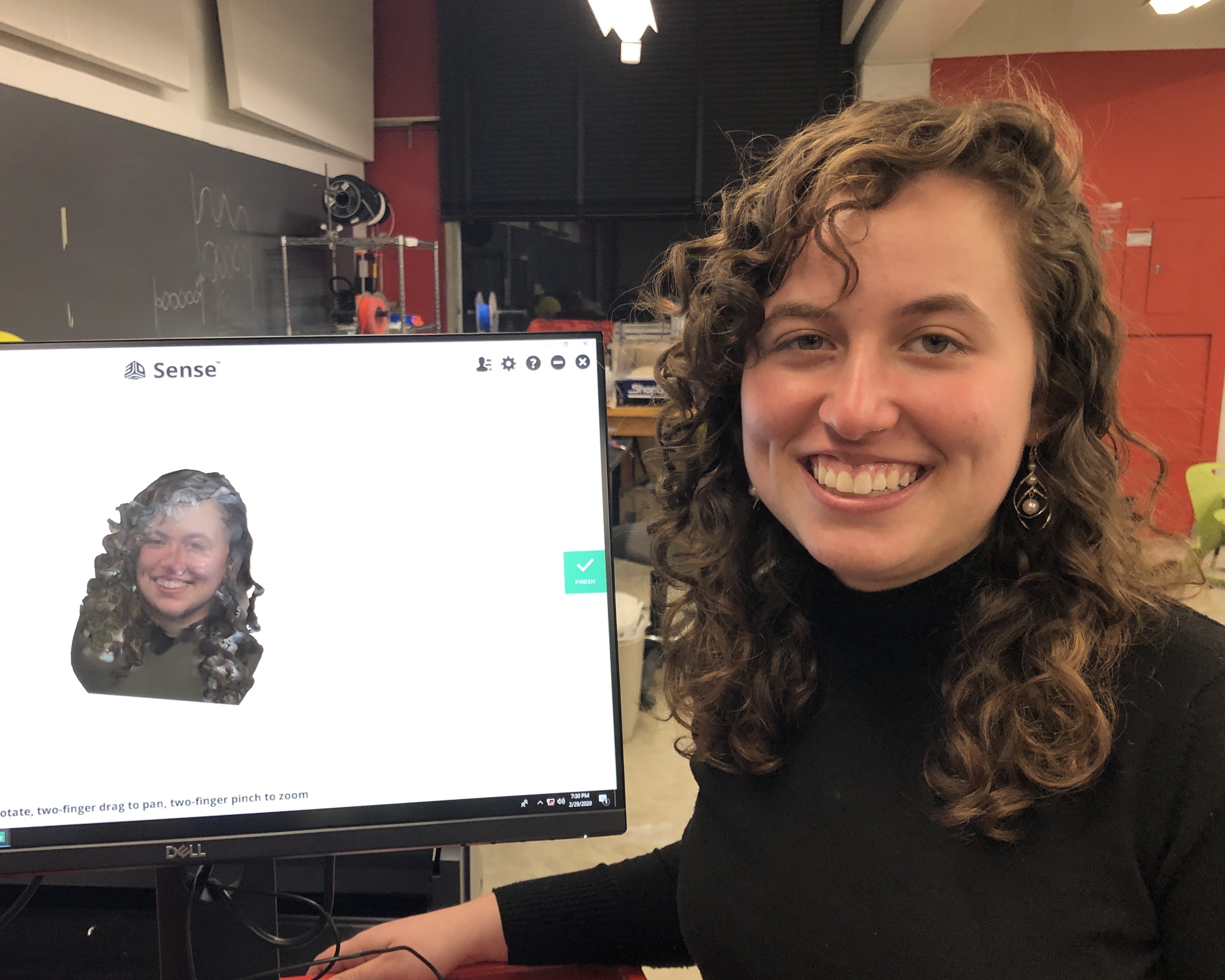
I patched over some holes and solidified the design so it would look more like a bust. Then, I began the process of slicing and dicing the file to transform it from an STL to g-code. Then I sent it off to the printer; we decided on an ambitious height of 7 cm and left it to run overnight for approximately 6.5 hours. After cleaning and sanding it, I am happy to report Rena is very pleased with the final product!